The Ad Spend
The agentic intelligence layer for advertising.
Git for ad accounts.
There has never been a version control layer for advertising. AI changes that.
It expires.
Google deletes change history after 90 days. Meta and LinkedIn store none.
It’s incompatible.
Three platforms, three schemas, zero unification. The data was too messy to be useful.
It was never built for reasoning.
Dashboards render charts. You can’t ask a chart why your CPA spiked.
LLMs change this. For the first time, that fragmented change data becomes a structured, queryable intelligence layer.
We built that layer.
There’s no system of record for advertising decisions.
The B2B team that just lost their best media buyer
Two years of optimization decisions — gone. The platforms deleted the history. The new hire starts from zero.
$25K–$32K/yr in lost productivity per marketer ramp
(ANA, Q2 2025)The agency managing 20 accounts with 3 people
Their clients ask “why did performance change?” and the honest answer is: we’re guessing.
Only 20% of CMOs can accurately measure marketing ROI
(Gartner 2025)The SMB running its own ads for the first time
A CPA spike happened Tuesday from Monday’s targeting change. They won’t see it until the weekly check-in.
Only 36.5% of global ad spend reaches the right target market
(ANA, Q2 2025)We didn’t research this problem. We lived it.
Ani spent a decade in the problem — enterprise, agency, and 40+ clients — before building the infrastructure to solve it.
Enterprise
Sr. Manager, Digital Marketing at RingCentral. Even well-resourced teams couldn’t explain what was actually working.
Agency
Founded The Matchbox, a HubSpot agency partner. ~25 people, 40+ clients, millions in managed spend. Canva and Siemens within 18 months, zero external capital.
The Pattern
Every client had the same gap. No one could trace a performance shift back to the decision that caused it.
Product
Built internal tools to solve it for our own team. Clients started asking for access. The Ad Spend was born — 137 companies onboarded, $68M+ in ad data analyzed.
3× founder. Built The Matchbox to millions in managed ad spend for Fortune 500 clients — zero external capital. TEDx speaker on AI in advertising. BA Economics, University of San Francisco.
Founding engineer at startup acquired by Noona (2021). Generated $120K+ ARR while reducing deployment times 98%. Built AI tools processing $300M in political data for UK transparency initiatives. BSc Computer Science (AI/ML), Heriot-Watt University.
Open-source IC at Vercel — ported Turborepo to Rust. Contracted at Meta on Buck2. Maintains Stripe’s leading Rust API library (async-stripe) — $3K/mo in Stripe sponsorships, 1.9M+ downloads. First Class Honours BSc Computer Science (90%+ avg, University Prize), Heriot-Watt University.
What we’ve built so far.
Instant visibility
One Slack command. Key metrics across every platform, in seconds. No logins, no seat licenses.
Causal anomaly detection
160+ algorithms running continuously. CPA spikes get connected to the targeting change that caused them.
Automated stakeholder reporting
The CFO gets ROAS. The CMO gets pipeline. The media buyer gets creative performance. Generated automatically.
Settings change attribution
Every change logged, timestamped, and linked to performance impact. Git for your ad accounts.
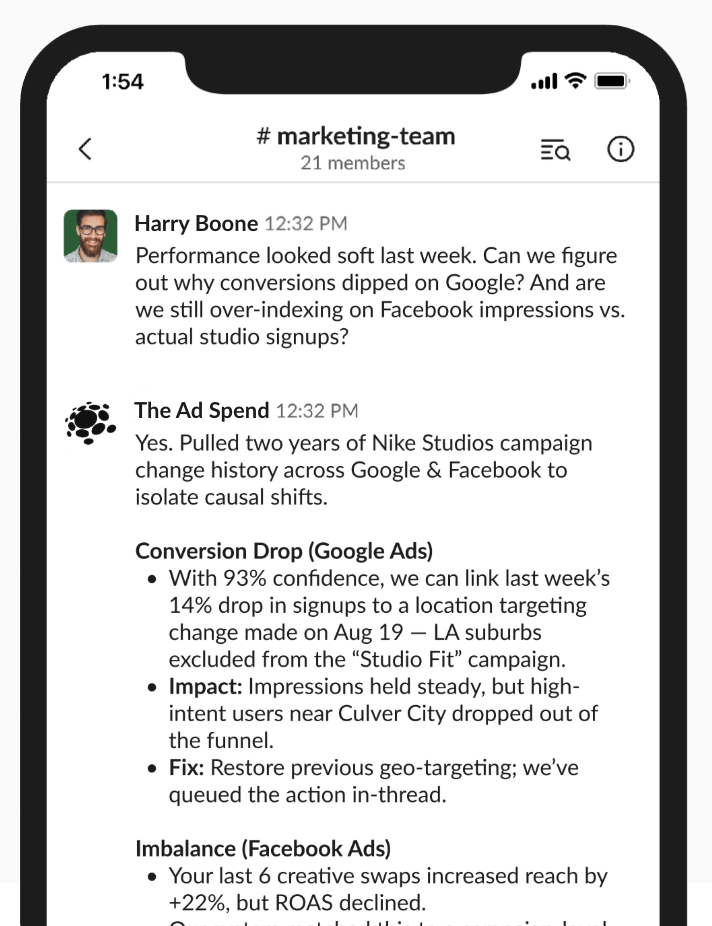
15-second install. Slack-native. No implementation. No seat licenses.
Coming soon: Conversational AI — query any ad account in plain English.
The platform that gets smarter with every dollar spent.
We're building the operating system for paid media. Five layers — each one replaces the next thing the team still does manually.
Every change across Google, Meta, and LinkedIn — logged, unified, and queryable. The system sees what changed, when, and connects it to what happened next. 160+ detection algorithms catch problems before they compound.
Layer 1 is LIVE. Layer 2 is in BETA.
Version control is how we get in. Each layer compounds on the last — until the entire paid media operation runs on one data layer.
137 companies. $68M+ in ad spend on the platform.
Majority B2B and agency customers. 60%+ either use HubSpot themselves or are agencies running HubSpot on behalf of their clients.
Interrupt Media
B2B agency. Doubled clients without adding headcount.
“This has fundamentally changed the way we run our business.”
Ben Lack, CEO, Interrupt Media
Free to paid. Each tier unlocks the next layer of intelligence.
Slack visibility, 5 alerts, 5 AI queries, weekly report, history browsing. The hook.
Full anomaly detection, unlimited alerts + AI chat, stakeholder rundowns, 365-day trend analysis.
AI optimizer with human approval queue. Budget shifts, one-click execution. The agentic layer.
+ ad spend feeRevenue attribution tied to specific ad decisions. HubSpot + Salesforce integration.
+ ad spend fee$39/client/mo (min 2). Average agency runs 8 clients = $312/mo recurring at zero incremental acquisition cost.
1 agency = 6–12 accounts
Built-in expansion channel.
Three fractures in the market. No competitor can bridge them.
DTC vs. B2B
nothing in betweenTriple Whale and Northbeam connect to Shopify purchase events — not CRM revenue. HockeyStack connects to HubSpot/Salesforce — but starts at $2,400+/mo. Nobody serves B2B teams at mid-market pricing.
Single-platform
vs. cross-platformMadgicx executes on Meta only. Albert.ai is cross-platform but requires $50K+/mo and zero explainability. Revealbot is rule-based — can’t detect patterns that weren’t pre-defined. AI-driven, cross-platform optimization with human approval at mid-market pricing doesn’t exist.
Multiple products
siloed dataTriple Whale’s attribution doesn’t talk to its anomaly detection. Optmyzr’s change history doesn’t feed its optimization. They built multiple surfaces on independent data models. The flywheel can’t turn.
Our position: One data layer. Cross-platform. B2B and DTC. Free to $499. No implementation, no seat licenses, 15-second install. 137 companies already on the platform.
We didn’t build for HubSpot’s ecosystem. We grew up inside it.
The Matchbox was a HubSpot partner. This intro came through a HubSpot customer we served.
All agency clients ran on HubSpot. 60%+ of our 137 Ad Spend accounts either use HubSpot themselves or are agencies who use HubSpot on behalf of their clients.
CRM integration was on our roadmap before this conversation — attribution needs deal pipeline data. Our CTO has already built HubSpot integrations for a prior company.
Your team has said agentic ad optimization won’t be built natively. We’re building it.
Product team access — CRM integration goes from roadmap to shipped faster. Arrows rebuilt a third of its product after Ventures gave them product team access.
Agency channel at scale — Partner Day, INBOUND, full solutions partner network. Programmatic distribution, not one-at-a-time.
Signal value — for a PLG tool, HubSpot Ventures on the cap table tells every B2B marketer in the ecosystem this is the endorsed solution.
Series A positioning — HubSpot Ventures + top-tier VC lead = ideal cap table for a company building the ad intelligence layer for B2B.
Dharmesh recently wrote that every successful GTM agent needs an agentic customer platform. Our optimization agents get smarter with HubSpot CRM context. HubSpot’s Breeze agents get smarter with ad intelligence signals. As attribution matures, the ad intelligence we generate becomes a natural extension of Breeze Intelligence — the same way Clearbit’s data became core to the platform. Your team tracks a $5‑to‑$1 ecosystem multiplier. We’re built to generate it.
$2M to get to Series A with three revenue layers live.
137 companies. 13 paying. 9.5% conversion — nearly 2× projected. Optimizer in beta.
137 → ~100 paying customers
HubSpot App Marketplace listing live
Agency channel activated
Optimizer GA. Approval queue + confidence scoring in market
$199/mo tier activated
Agency multiplier compounding
HubSpot CRM integration live
Fluid Touch Attribution in early beta
$499/mo tier in pilot
2 engineers to ship Optimizer and begin Attribution. Every dollar of product spend directly unlocks the next revenue tier.
PLG distribution, agency channel, HubSpot Marketplace.
Three founders. Infrastructure. Lean by design.
The Ad Spend
The version control layer for advertising.